
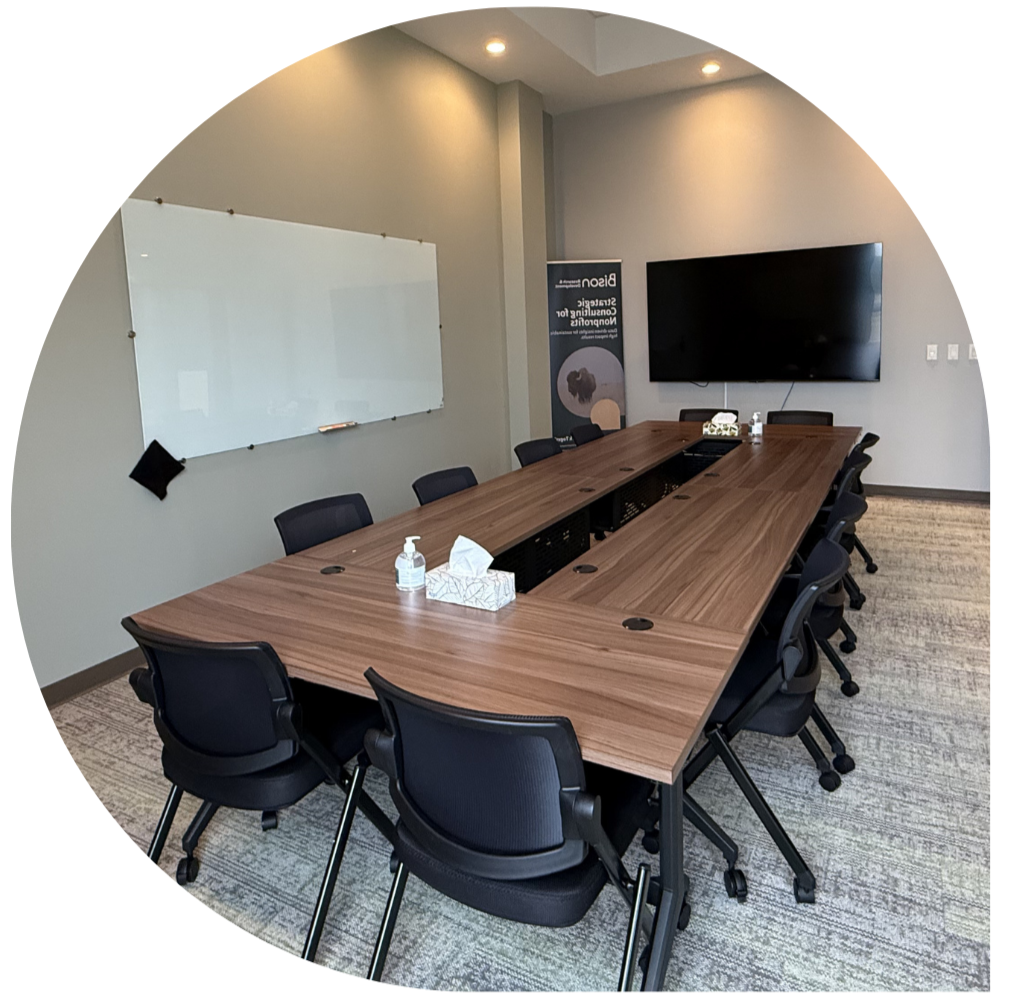
Custom, in-person workshops
Our new space accommodates up to 18 people for in-person or hybrid half-day and full-day workshops. Any topic can be tailored to your team's specific needs.

WORKSHOPS AVAILABLE ON DEMAND
-
Non-profit and charitable organizations are called upon to justify their work regularly; whether it be to funders, to community leaders, or to clients, there is always a need to show the value of the investment in terms of impact, change, and outcomes.
This workshop will provide knowledge and basic research skills related to the various methods and means to gather, interpret and share data in non-profit environments. These methods include commonly used assessments, including Needs Assessments, SWOT/SOAR Analysis, and Market and Workforce Assessments, and will also cover the preparation of Briefing Notes that highlight issues and suggest options for change. Other topics covered will include ethics, developing research questions, weaving cultural sensitivity and safety into the research process, and ensuring that community and clients are centred and involved along the way.
Participants will leave with a research action plan that can be easily and readily implemented in the organization, along with supporting materials and resources to support the work.
-
Non-profit and charitable organizations are the lifeblood of our community. Not only do they respond to emerging needs in real time, they work proactively to improve society and promote social change. A common issue faced by many organizations engaged in this work is that responding to emerging needs leads to programs and services developing “on the fly,” which can pose risks to the community, staff, and to the organization as a whole. This is where Program Development comes in – when applied systematically to programs and services, it helps to promote stability, sustainability, and success for both your staff and your clients.
This workshop will provide basic, entry level skills, tools and resources to help you and your non-profit/charitable organization structure your program or service using Program Development theory and methods. You will be offered concrete skills, applicable tools and templates, and background resources that can be used for a program or service that you are either thinking of starting, or that is currently running (and potentially running away from you)!
-
In 2023, demand for services from Canadian non-profits rose by 46.1%, while organizational capacity to meet that demand fell by 13.2% (Statistics Canada, 2024). This growing gap, alongside shifting socio-political and cultural dynamics, underscores the urgent need for non-profits to diversify revenue streams and strengthen long-term sustainability.
This half-day, in-person workshop offers a clear snapshot of current trends affecting the non-profit sector and introduces practical strategies that organizations can adapt to their own contexts. Participants will explore approaches such as social enterprise and self-generating revenue initiatives, strategic fund development planning, and data-driven advocacy to strengthen their competitive edge.
By the end of the session, participants will leave with both insight and practical tools to help reduce reliance on government funding while enhancing their organization’s overall sustainability and resilience.
-
Non-profit organization policies are required to govern and operationalize the work of the corporation, however they are often the least exciting and last priority on the executive to-do list! Despite this, they are a crucial component to ensure compliance with legal and regulatory requirements, and can be a key aspect of the organization’s efforts to weave, diversity, equity, inclusion and decolonizing values into their work.
This half-day, virtual workshop will review contemporary trends in policy development across the non-profit sector while sharing resources and tools for leaders to begin engaging in policy development as transformative, social justice work.
Participants will leave with policy audit tools, policy templates, and other resources to support them in reviewing and updating their operational and governance policies.
-
Non-Profit Organizations throughout health, education and social services routinely encounter challenging situations throughout the course of their work serving the community, whether through direct client interactions, exposure to crises, or the cumulative strain of organizational pressures. While it is common for such organizations to support their students, clients and community members to weather traumatic events in their lives, many organizations lack the structures, skills, and tools needed to recognize, respond to, and repair the impacts of trauma at the organizational level. Examples include sudden loss within the team or client base, experiencing critical incidents once or routinely/repetitively as part of the work, or managing the negative and/or unanticipated outcomes of organizational change. Organizational trauma is not unlike personal trauma; without active and intentional support, the effects can be dire, including diminishing well-being, performance, and trust, leading to negative impacts on the culture of the organization and the programs and services it provides for the community.
This half-day, virtual workshop introduces participants to a trauma-informed approach designed to help individuals and teams understand, navigate, and heal from organizational trauma.
Facilitated by Sarah Dack, Registered Marriage and Family Therapist, and Jared Star, CEO of Bison Research and Development, this session combines theory with practical tools to support both personal recovery and organizational resilience.
-
This workshop is intended for individuals responsible for planning, commissioning, or managing evaluations, particularly those working in nonprofit and government organizations. Participants will learn how to translate an evaluation idea into a practical plan, considering evaluation readiness, intended use, available evidence, stakeholder involvement, timelines, and resources.
-
This workshop focuses on helping participants communicate evaluation findings effectively and translate them into organizational decisions and improvements. It covers developing evidence-based conclusions and recommendations, preparing decision-focused reporting products, and establishing processes for following up on recommendations.